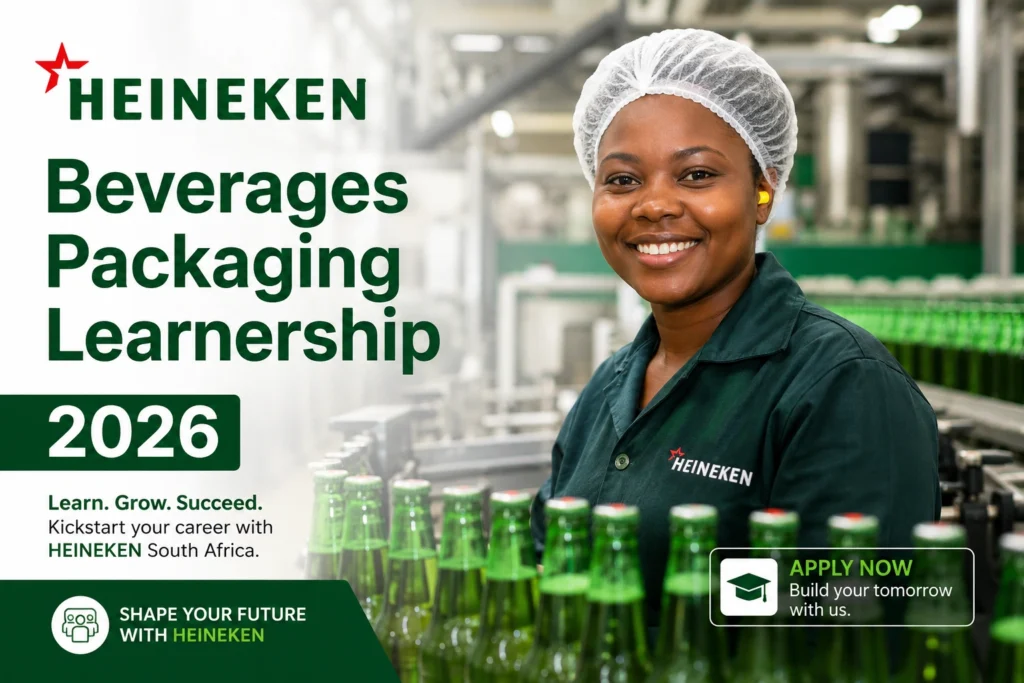
Heineken Packaging Learnership 2026: Complete Guide to the NQF Level 3 Packaging Operations Opportunity at Sedibeng Manufacturing Plant
The manufacturing and production industry remains one of the most important sectors in South Africa because it creates employment opportunities, develops technical skills, and provides young people with practical workplace experience. Many unemployed youth are searching for opportunities that can help them gain industry knowledge while building a stable future. One opportunity attracting attention is the Heineken Packaging Learnership at the Sedibeng Manufacturing Plant.
This Packaging Operations Learnership gives qualifying candidates an opportunity to gain practical experience and theoretical training within a real manufacturing environment. The programme is designed for individuals who are interested in technical operations, packaging processes, machinery, production systems, and workplace safety procedures. Learners who successfully complete the programme can improve their chances of finding employment within the manufacturing, beverage, packaging, and production sectors.
The learnership combines classroom learning with hands-on workplace exposure. This means learners do not only study theory, but they also participate in real operational activities inside a manufacturing plant. The experience gained during the programme can help participants develop confidence, technical understanding, teamwork skills, and operational discipline.
In South Africa, learnerships are highly valuable because they help bridge the gap between education and employment. Many young people complete Grade 12 but struggle to obtain work experience. Employers often look for candidates with practical exposure, which makes learnership programmes important stepping stones toward long-term careers.
The Heineken Packaging Learnership focuses on packaging operations at NQF Level 3. This qualification helps learners understand production processes, quality standards, equipment maintenance, packaging procedures, and workplace safety requirements. Participants are exposed to the daily activities that take place inside a modern manufacturing plant.
Understanding the Heineken Packaging Learnership
The Packaging Operations Learnership is structured to equip learners with practical and theoretical knowledge related to manufacturing and packaging systems. The programme is hosted at the Sedibeng Manufacturing Plant, where learners work in an operational production environment while receiving formal training.
The manufacturing industry depends heavily on efficient packaging systems because packaging plays a critical role in product protection, quality assurance, storage, transportation, and customer satisfaction. Products must be packaged correctly to maintain quality standards and ensure safe delivery to consumers.
Learners participating in this programme are introduced to the systems and procedures used within a professional packaging facility. They learn how products move through different stages of production and how operational teams work together to ensure efficiency and quality.
The learnership also helps participants understand the importance of teamwork, communication, discipline, safety, and problem-solving in a production environment. Manufacturing plants rely on employees who can follow procedures carefully, respond quickly to operational issues, and maintain high production standards.
What is an NQF Level 3 Packaging Operations Learnership?
An NQF Level 3 qualification is a nationally recognised qualification registered on South Africa’s National Qualifications Framework. It provides learners with industry-related skills and knowledge that can improve employability and career development opportunities.
The Packaging Operations qualification focuses on operational procedures used in manufacturing and packaging facilities. Learners are trained to understand machinery, production processes, safety regulations, packaging standards, and quality control systems.
The qualification includes practical workplace experience, allowing learners to apply their knowledge within a real manufacturing environment. This approach helps learners gain confidence while developing industry-relevant competencies.
An NQF Level 3 qualification can also create opportunities for further studies and career progression within technical and manufacturing industries. Individuals who complete learnerships often pursue additional training, apprenticeships, or advanced technical qualifications later in their careers.
Why Manufacturing Learnerships Are Important in South Africa
South Africa faces significant youth unemployment challenges, especially among young people who lack work experience. Many school leavers struggle to enter the job market because they do not have technical skills or practical exposure.
Learnerships help address this problem by combining education and workplace training. Participants gain experience while learning important skills required by employers. This improves employability and helps young people become more competitive in the labour market.
Manufacturing learnerships are particularly valuable because the production sector requires skilled workers who understand machinery, operational systems, safety standards, and quality control procedures. Companies invest in training programmes because skilled employees contribute to operational efficiency and productivity.
Technical industries also offer long-term career opportunities for motivated individuals. Workers can grow into positions such as machine operators, supervisors, technicians, quality controllers, maintenance assistants, and production coordinators.
The Heineken Packaging Learnership provides an important opportunity for individuals interested in entering the manufacturing sector and gaining industry exposure.
Packaging Operations in a Manufacturing Plant
Packaging operations involve various activities that ensure products are packed correctly and safely before distribution. Manufacturing plants use advanced systems and equipment to package products efficiently while maintaining quality standards.
Packaging operations may include:
- Product filling processes
- Product sealing procedures
- Labelling operations
- Packaging inspection
- Equipment operation
- Quality monitoring
- Stock handling
- Machine maintenance
- Safety compliance
- Cleaning procedures
Each stage of packaging must follow strict operational standards to prevent product damage, contamination, or quality problems.
Learners in the programme gain insight into these processes while working alongside experienced operational teams.
Areas Covered During the Learnership
The learnership exposes participants to several important operational areas within packaging and manufacturing environments.
Product Sealing Procedures
Product sealing is an important part of packaging because it protects products from contamination, damage, and leakage. Learners are taught how sealing systems operate and how quality standards are maintained during the sealing process.
They may also learn how to identify sealing defects and report operational issues that could affect product quality.
Packing and Unpacking Operations
Packing operations involve preparing products for storage and transportation. Learners gain experience in handling products correctly, arranging packaging materials, and ensuring packaging procedures meet operational requirements.
Unpacking procedures are also important because materials and products must be handled carefully to prevent damage and maintain safety standards.
Product Labelling Processes
Labelling is essential in manufacturing because products require accurate information, branding, and compliance markings. Learners are introduced to labelling systems and procedures used in production facilities.
They learn the importance of accuracy in labelling processes because incorrect labels can affect product quality, customer trust, and regulatory compliance.
First-Line Equipment Maintenance
Machines and equipment are critical components of manufacturing operations. Learners receive basic training in first-line maintenance procedures to help ensure equipment operates efficiently.
This may include:
- Identifying equipment faults
- Conducting basic inspections
- Reporting technical problems
- Cleaning machinery
- Monitoring equipment performance
Understanding maintenance procedures helps reduce downtime and supports operational efficiency.
Problem-Solving Techniques and Methods
Production environments often face operational challenges that require quick thinking and effective problem-solving. Learners develop skills that help them identify issues and respond appropriately.
Problem-solving training may include:
- Identifying operational problems
- Understanding production interruptions
- Reporting faults
- Working with teams to resolve issues
- Following operational procedures during emergencies
These skills are important because manufacturing environments depend on efficiency and teamwork.
Workplace Health and Safety Regulations
Safety is one of the most important aspects of any manufacturing environment. Production facilities contain machinery, equipment, moving parts, chemicals, and operational risks that require strict safety compliance.
Learners are trained on workplace safety procedures such as:
- Wearing protective clothing
- Following safety instructions
- Understanding hazard awareness
- Emergency procedures
- Safe equipment handling
- Maintaining clean work areas
Employees who understand workplace safety contribute to a safer and more productive environment.
Quality Control Procedures
Manufacturing companies must maintain consistent product quality to satisfy customers and meet industry standards. Learners are introduced to quality control systems used in packaging operations.
Quality control may involve:
- Inspecting packaged products
- Identifying defects
- Monitoring packaging standards
- Reporting quality concerns
- Following operational procedures
Understanding quality systems helps learners appreciate the importance of accuracy and consistency in manufacturing.
Asset and Equipment Management
Manufacturing facilities rely on valuable operational equipment and production assets. Learners are introduced to asset management procedures that help protect equipment and improve operational efficiency.
This includes understanding how machinery is monitored, maintained, and used within production environments.
Teamwork and Workplace Experience
One of the most valuable parts of a learnership is workplace exposure. Learners interact with supervisors, machine operators, technicians, and production staff while gaining practical experience.
Working within a team environment teaches participants important workplace skills such as:
- Communication
- Cooperation
- Time management
- Responsibility
- Discipline
- Problem-solving
- Professional conduct
These skills are valuable in almost every industry and can help learners succeed in future employment opportunities.
Minimum Requirements for the Learnership
Applicants interested in the Heineken Packaging Learnership must meet specific requirements before applying.
Grade 12 / Matric Certificate
Candidates must have completed Matric or Grade 12. This educational requirement ensures applicants have basic academic knowledge necessary for technical training and operational understanding.
Pure Mathematics
Mathematics is important in manufacturing because operational processes often involve measurements, calculations, machine settings, production monitoring, and problem-solving.
Applicants who performed well in Mathematics may have an advantage during the selection process.
English as a Subject
Good communication skills are essential in manufacturing environments. Learners must understand instructions, safety procedures, operational guidelines, and workplace communication.
English proficiency helps learners communicate effectively with supervisors and team members.
Preferred Candidate Qualities
The company may give preference to applicants with strong academic results and technical interest. However, personal qualities and attitude are also important during the selection process.
Strong Technical and Mechanical Interest
Manufacturing environments involve machinery, operational systems, and technical processes. Candidates who enjoy understanding how equipment works may adapt well to the programme.
Technical curiosity often helps learners develop confidence in operational roles.
Ability to Understand Operational Processes
Packaging operations require attention to detail and understanding of procedures. Learners must follow instructions carefully and understand production workflows.
Operational awareness is important for maintaining productivity and quality standards.
Good Communication Skills
Communication is essential in workplace environments. Learners must communicate with team members, supervisors, and technical staff clearly and professionally.
Strong communication skills also help improve teamwork and problem-solving.
Ability to Work Under Pressure
Manufacturing facilities can be fast-paced environments where employees must meet production targets and operational deadlines.
Candidates who remain calm and focused under pressure may perform better in operational settings.
Willingness to Learn
Learnerships are training opportunities designed for individuals who are eager to develop skills and gain experience.
A positive attitude and willingness to learn can help participants succeed during the programme.
Understanding Workplace Safety
Safety awareness is critical in manufacturing environments. Learners who understand the importance of workplace safety procedures contribute to a safer production environment.
Benefits of Joining a Packaging Learnership
Participating in a learnership can provide several important advantages for young job seekers.
Practical Work Experience
Many employers prefer candidates with workplace experience. Learnerships provide hands-on exposure that improves employability.
Industry Knowledge
Learners gain insight into manufacturing systems, packaging operations, and industrial procedures.
Skills Development
Participants develop technical, operational, communication, and teamwork skills.
Career Exposure
The programme introduces learners to potential career paths within manufacturing and production industries.
Improved Confidence
Workplace experience helps participants become more confident and professional.
National Qualification
Completing an NQF Level 3 qualification strengthens a learner’s CV and improves future opportunities.
Career Opportunities After Completion
Completing a packaging operations learnership may open doors to several career opportunities within manufacturing and production industries.
Possible career paths include:
- Packaging operator
- Production assistant
- Machine operator
- Quality controller
- Manufacturing assistant
- Warehouse assistant
- Process operator
- Production coordinator
- Technical assistant
- Operations support worker
Some learners may also pursue further technical training or advanced qualifications.
Importance of Mathematics in Manufacturing
Mathematics plays a major role in technical industries. Manufacturing employees often work with measurements, production quantities, machine settings, and operational calculations.
Mathematical skills may help workers:
- Monitor production output
- Calculate packaging quantities
- Understand machine settings
- Analyse operational data
- Measure materials accurately
Candidates with strong mathematical ability may adapt more easily to technical environments.
Workplace Safety in Manufacturing
Safety is a critical part of industrial operations because manufacturing plants contain moving machinery, automated systems, electrical equipment, and operational hazards.
Companies invest heavily in safety training because workplace accidents can affect employees, production processes, and operational efficiency.
Important safety practices include:
- Wearing personal protective equipment
- Following safety procedures
- Reporting hazards
- Keeping work areas clean
- Understanding emergency procedures
- Operating equipment responsibly
Employees who follow safety procedures help create a secure working environment.
The Role of Quality Control in Packaging
Quality control ensures products meet required standards before reaching consumers. Packaging quality affects product safety, customer satisfaction, and company reputation.
Quality control procedures may include:
- Checking product appearance
- Monitoring packaging integrity
- Verifying labels
- Inspecting seals
- Measuring packaging accuracy
Attention to detail is extremely important in quality control environments.
How Learnerships Help Build Confidence
Many young people entering the workplace for the first time feel uncertain or nervous about professional environments. Learnerships provide structured exposure that helps participants build confidence gradually.
Learners gain confidence through:
- Practical training
- Workplace interaction
- Skills development
- Teamwork experience
- Completing operational tasks
- Learning new systems
Confidence gained during a learnership can improve future job performance and career development.
Working in a Manufacturing Environment
Manufacturing environments can be exciting for individuals who enjoy practical work and technical systems. Production facilities often operate using advanced machinery, automated systems, and coordinated operational teams.
Employees may work shifts depending on operational requirements. Production environments also require discipline, punctuality, teamwork, and attention to detail.
Individuals interested in manufacturing careers should be prepared for active working conditions and operational responsibilities.
Preparing for the Application Process
Applicants should ensure they meet all requirements before applying. Preparation can improve the chances of being shortlisted.
Important preparation steps may include:
- Updating your CV
- Preparing certified documents
- Checking academic results
- Improving communication skills
- Learning about manufacturing operations
- Practising interview skills
Candidates should also ensure their contact information is accurate and professional.
Tips for Creating a Strong CV
A professional CV can improve the chances of being noticed during recruitment.
A good CV should include:
- Personal information
- Educational background
- Subjects completed
- Skills and strengths
- Achievements
- Contact details
Applicants should ensure their CV is neat, accurate, and free from spelling mistakes.
Interview Preparation Tips
Shortlisted candidates may be invited for interviews or assessments.
Helpful interview tips include:
- Arrive on time
- Dress neatly
- Speak clearly
- Be honest
- Show enthusiasm
- Demonstrate willingness to learn
- Display confidence and professionalism
Candidates may also benefit from researching manufacturing operations and workplace safety concepts before interviews.
Importance of Discipline in Manufacturing
Discipline is important in production environments because operational systems rely on consistency and teamwork.
Employees are expected to:
- Follow instructions
- Arrive on time
- Maintain safety standards
- Respect procedures
- Work responsibly
Reliable employees often perform better and create positive impressions within workplace environments.
Learning Technical Skills Through Experience
One of the best ways to learn technical skills is through practical experience. Learnerships provide direct exposure to equipment, systems, and operational procedures.
Practical learning helps participants:
- Understand machinery
- Improve technical confidence
- Develop operational knowledge
- Build problem-solving skills
Hands-on experience is valuable because it prepares learners for real workplace responsibilities.
Manufacturing Careers in South Africa
The manufacturing sector continues to provide important employment opportunities across South Africa. Industries such as food production, beverages, packaging, logistics, engineering, and industrial processing require trained workers.
Technical careers are often attractive because they provide opportunities for growth, specialization, and long-term employment.
Individuals who begin with learnerships can gradually progress into more advanced technical or supervisory roles.
Why Young People Should Consider Learnerships
Learnerships provide important opportunities for young people who want to gain experience and improve their employability.
Benefits include:
- Workplace exposure
- Industry training
- Skills development
- Networking opportunities
- Improved confidence
- Better employment prospects
For many participants, a learnership becomes the starting point of a successful career journey.
Final Thoughts
The Heineken Packaging Learnership at the Sedibeng Manufacturing Plant offers a valuable opportunity for motivated individuals who want to build careers within the manufacturing and packaging industry. Through this NQF Level 3 Packaging Operations Learnership, participants gain practical exposure, technical understanding, and workplace experience within a professional production environment.
The programme focuses on important operational areas such as packaging procedures, product labelling, equipment maintenance, quality control, workplace safety, and problem-solving. Learners also develop teamwork, communication, and operational discipline that can support future career growth.
For young South Africans seeking practical training and industry exposure, learnerships remain one of the best ways to enter the workforce. They help bridge the gap between education and employment while providing learners with real-world experience that employers value.
Candidates who meet the requirements and demonstrate a strong willingness to learn may benefit greatly from this opportunity. The skills gained during the programme can create pathways toward employment, further training, and long-term career development within South Africa’s manufacturing sector.