WIIP 2027 Graduate Programme: Applications Open for Unemployed South African Graduates – Apply Before 30 October 2026
The WIIP 2027 Graduate Programme is inviting eligible South African graduates to apply for an opportunity to gain valuable experience and develop their professional skills. The programme is aimed at unemployed South African citizens who have graduated from a university or TVET college and are looking for opportunities to enter the world of work.
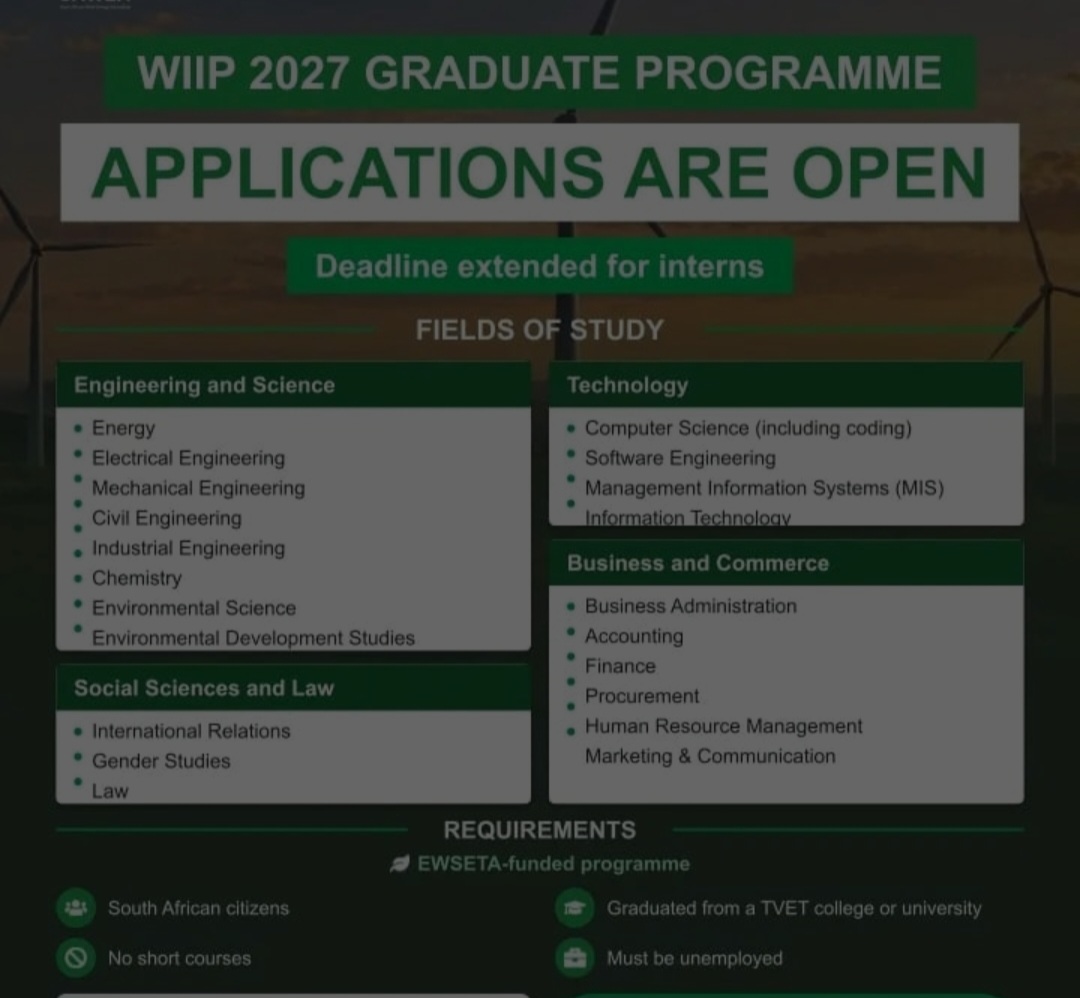
According to the application poster, the programme is funded by the Energy and Water Sector Education and Training Authority (EWSETA) and covers a wide range of study fields, including engineering, science, technology, business, commerce, social sciences and law.
Applications are open, and interested candidates are encouraged to submit their applications before the closing date of 30 October 2026.
For graduates who have been struggling to find employment after completing their qualifications, this programme may provide an opportunity to gain practical workplace exposure and strengthen their career prospects.
About the WIIP 2027 Graduate Programme
Finding employment after graduation can be challenging, particularly for young people who have the necessary academic qualifications but lack practical workplace experience. Many employers look for candidates who understand their field of study and can apply their knowledge in a professional environment.
Graduate programmes and internships can help bridge this gap by connecting qualified candidates with opportunities to develop practical skills, understand workplace expectations and prepare for future employment.
The WIIP 2027 Graduate Programme is presented as an opportunity for unemployed graduates from different academic backgrounds. Its listed fields of study suggest that applications are welcomed from candidates with qualifications in technical, scientific, business, information technology and social science disciplines.
The programme is EWSETA-funded, according to the poster. However, applicants should consult the official application information to confirm the available placements, programme duration, participating host organisations and any additional conditions.
Candidates should also note that the poster does not specify a monthly stipend or salary. Applicants should verify whether financial support is offered before making assumptions about remuneration.
Fields of Study Covered by the WIIP 2027 Programme
The programme advertises opportunities across several academic disciplines. Graduates should check the list below to determine whether their qualifications match one of the advertised fields.
1. Engineering and Science
The following fields are listed under Engineering and Science:
- Energy
- Electrical Engineering
- Mechanical Engineering
- Civil Engineering
- Industrial Engineering
- Chemistry
- Environmental Science
- Environmental Development Studies
Graduates with qualifications in these disciplines may be interested in opportunities related to technical work, research, engineering operations, environmental management and energy-related activities.
Electrical engineering graduates may be interested in technical systems, electrical infrastructure and related engineering environments. Mechanical engineering graduates may look for opportunities involving machinery, equipment and maintenance-related activities.
Civil engineering graduates may be interested in infrastructure, construction and project-related work, while industrial engineering graduates may explore opportunities connected to process improvement, operations and efficiency.
Candidates with qualifications in chemistry, environmental science and environmental development studies may be interested in scientific, environmental and sustainability-related work.
Applicants must ensure that their qualifications meet the requirements of the particular placement for which they are applying.
2. Technology
The poster lists the following technology-related fields:
- Computer Science, including coding
- Software Engineering
- Management Information Systems (MIS)
- Information Technology
These fields may be suitable for graduates who want to build careers in the technology sector.
Computer science graduates may be interested in programming, coding, software development and technical problem-solving. Software engineering graduates may seek experience in the development, testing and maintenance of software applications.
Management Information Systems graduates may be interested in roles that connect business operations with information systems, while information technology graduates may explore technical support, IT operations, systems administration and related fields.
As digital technology continues to play an important role in business and industry, practical experience can help graduates strengthen their technical knowledge and demonstrate their abilities to future employers.
Applicants should ensure that they select the appropriate field and provide accurate details about their qualifications.
3. Business and Commerce
The Business and Commerce category includes the following study fields:
- Business Administration
- Accounting
- Finance
- Procurement
- Human Resource Management
- Marketing and Communication
Graduates in these disciplines may be interested in developing careers in administration, financial services, procurement, human resources, marketing and business operations.
Business administration graduates may seek experience in office administration, organisational support and business processes.
Accounting and finance graduates may be interested in financial administration, reporting, budgeting and related activities, depending on the requirements of the placement.
Procurement graduates may explore purchasing processes, supplier administration and supply chain support. Human resource management graduates may seek exposure to recruitment, employee administration and workplace policies.
Marketing and communication graduates may be interested in content development, communication planning, marketing support and stakeholder engagement.
The availability of specific positions will depend on the programme’s participating host organisations and the requirements of each placement.
4. Social Sciences and Law
The programme also lists the following fields under Social Sciences and Law:
- International Relations
- Gender Studies
- Law
Graduates in these disciplines may be interested in opportunities involving research, administration, policy support, legal services and organisational development, depending on the available placement.
International relations graduates may seek experience in research, stakeholder engagement and international or public affairs-related work.
Gender studies graduates may be interested in research, social development, equality initiatives and related programmes.
Law graduates may seek relevant exposure to legal administration, compliance, research or other work appropriate to their qualifications.
Applicants should remember that a graduate placement does not automatically qualify someone to practise as a lawyer or in another regulated profession. Any professional registration or additional requirements must be met separately.
WIIP 2027 Graduate Programme Requirements
According to the recruitment poster, applicants must meet the following requirements.
1. Must Be a South African Citizen
The programme is advertised for South African citizens. Applicants should be prepared to provide valid documentation confirming their citizenship if requested during the application or verification process.
Candidates who do not meet this requirement should check the official programme information before applying.
2. Must Have Graduated From a TVET College or University
Applicants must have graduated from a TVET college or university.
The advertised fields cover several academic disciplines, but the poster does not specify a minimum qualification level, a minimum academic average or whether every listed field requires a particular type of qualification.
Graduates should therefore confirm that their completed qualification is accepted for their intended field or placement.
Applicants should ensure that the qualification details entered on the application form match their official academic records.
3. Must Be Unemployed
The poster states that candidates must be unemployed.
This means that the opportunity is intended for people who are currently without employment. Applicants should answer all questions about their employment status honestly and provide any information requested by the programme administrators.
If a candidate is unsure whether their current circumstances meet the programme’s definition of unemployed, they should contact the official programme administrators for clarification.
4. Short Courses Are Not Accepted as the Required Qualification
The poster specifically states that short courses are not accepted.
Applicants should therefore apply using their completed university or TVET college qualifications, rather than relying on a short course alone to meet the educational requirement.
Candidates who have completed an accredited qualification and additional short courses should provide the details requested on the application form and verify which qualification is relevant to the placement.
Documents to Prepare Before Applying
The poster does not provide a complete list of supporting documents. However, applicants can prepare their standard graduate application documents in advance and follow the official instructions for submission.
Potentially useful documents include:
- An updated curriculum vitae (CV).
- A certified copy of the relevant qualification, if requested.
- Academic transcripts, if requested.
- A copy of a South African identity document, if requested.
- Contact details for professional or academic references, if required.
Important: This is a preparation checklist, not a confirmed official document list. Applicants must follow the actual requirements on the official application form and should not upload unnecessary personal information.
Your CV should clearly state your qualifications, institution, year of completion, relevant skills, academic projects and any previous work exposure or volunteering experience.
If you do not have formal work experience, focus on relevant coursework, practical assignments, research projects, computer skills, teamwork and other abilities that demonstrate your readiness for the workplace.
How to Apply for the WIIP 2027 Graduate Programme
The recruitment poster provides a dedicated application link for interns.
Interested applicants should follow these steps:
Step 1: Visit the official application page
Open the internship application link displayed on the poster:
https://sawea.org.za/form/wiip-intern-2027
Check that the page corresponds to the WIIP 2027 intern application before entering your details.
Step 2: Read the application instructions
Carefully review the instructions on the application form. Confirm the eligibility criteria, qualification requirements and any additional information required from applicants.
Do not assume that meeting the general requirements automatically guarantees selection.
Step 3: Complete your personal details
Enter your personal information accurately. Make sure your contact number and email address are correct so that programme administrators can reach you if necessary.
Step 4: Provide your academic information
Enter the details of your university or TVET college qualification, including your field of study and completion information.
Choose the field that most closely matches your qualification, where the form requires you to select one.
Step 5: Upload the required supporting documents
Prepare and upload the documents requested by the official application form. Check that your files are readable and that your information is consistent across all documents.
Step 6: Review your application
Before submitting, check your personal details, academic information, contact details and uploaded documents. Correct any errors you identify.
Step 7: Submit before the closing date
Submit your completed application before 30 October 2026. Do not wait until the last minute, as technical problems or incomplete documentation could delay submission.
If the website provides a confirmation message or reference number, save it for your records.
Internship Application and Host Company Application
The poster provides two separate links: one for intern applications and another for host companies.
The intern application link is:
https://sawea.org.za/form/wiip-intern-2027
The host company application link is:
https://sawea.org.za/form/wiip-host-company-2027
Applicants seeking an internship or graduate placement should use the intern application link. The host company link is intended for organisations interested in participating as hosts, rather than for individual graduates applying for placements.
Using the correct application link can help prevent confusion and ensure that your submission reaches the appropriate process.
Closing Date for the WIIP 2027 Graduate Programme
The closing date advertised on the poster is 30 October 2026.
Applicants should treat this date as an important deadline and aim to submit their applications well in advance.
Before submitting, check the official application page for any updates, revised instructions or additional requirements. Although the poster indicates that the deadline has been extended for interns, it gives 30 October 2026 as the closing date.
Do not assume that late applications will be accepted unless the programme administrators explicitly announce a further extension.
What Happens After You Apply?
Submitting an application is the first step in the recruitment process. Applicants may need to wait while the programme administrators review submissions and determine which candidates meet the requirements.
The poster states that applicants who have not heard from the programme by December 2026 should consider their applications unsuccessful.
This is an important point for candidates to remember when managing their expectations.
Applicants should monitor their email accounts and telephone messages for any communication from the programme administrators. They should also check their spam or junk email folders periodically.
While waiting for feedback, graduates can continue looking for other internships, learnerships, graduate programmes and entry-level vacancies.
Applicants should not resign from an existing opportunity, make financial commitments or assume that they have been selected unless they receive formal confirmation.
Why Graduates Should Consider Applying
Graduate programmes can offer several potential benefits to people entering the job market.
Practical Workplace Exposure
A relevant placement may help graduates understand how the knowledge gained during their studies is applied in a professional environment.
Depending on the role, participants may gain exposure to workplace systems, projects, professional communication and daily operational responsibilities.
Skills Development
Practical experience can help graduates develop technical and transferable skills. These may include communication, teamwork, time management, problem-solving and the ability to work under supervision.
The skills gained will depend on the placement and the responsibilities assigned to each participant.
Improved Employability
Relevant workplace experience can strengthen a CV and help candidates explain their abilities to future employers.
Although participation cannot guarantee permanent employment, a well-matched placement may help graduates demonstrate their readiness for entry-level professional roles.
Professional Networking
A graduate programme may provide opportunities to interact with experienced professionals, colleagues and supervisors.
Building professional relationships can help participants learn more about their industries and understand potential career pathways.
Career Direction
Graduates who are uncertain about their long-term career goals may benefit from exposure to real workplace responsibilities.
A relevant placement can help them identify the skills they enjoy using, the types of roles that suit them and the areas in which they need further development.
Tips for Submitting a Strong Application
Competition for graduate opportunities can be high, so applicants should take time to prepare a complete and professional submission.
- Use an updated CV: Include your qualification, institution, relevant skills and practical academic experience.
- Check your eligibility: Make sure you meet the citizenship, unemployment and qualification requirements.
- Match your field of study: Ensure the information in your application reflects your actual qualification.
- Provide accurate information: Do not exaggerate your experience or submit false academic details.
- Prepare readable documents: Follow the requested file formats and document instructions.
- Use a professional email address: Check your inbox regularly after applying.
- Submit early: Do not wait until the final hours before the deadline.
- Keep a copy of your application: Save your CV, supporting documents and any submission confirmation.
- Continue applying elsewhere: A graduate programme is an opportunity, but selection is not guaranteed.
Frequently Asked Questions
1. Is the WIIP 2027 Graduate Programme open for applications?
According to the supplied poster, applications are open for the WIIP 2027 Graduate Programme.
2. What is the closing date?
The advertised closing date is 30 October 2026.
3. Who can apply?
The poster specifies South African citizens who have graduated from a TVET college or university and are unemployed.
4. Can applicants with only short courses apply?
The poster states that short courses are not accepted as the required qualification.
5. Which fields of study are covered?
The advertised fields include engineering, science, technology, business, commerce, international relations, gender studies and law.
6. Is the programme funded?
Yes. The poster identifies the programme as EWSETA-funded.
7. How much is the monthly stipend?
The supplied poster does not state a stipend amount. Applicants should confirm remuneration or financial support through the official programme administrators.
8. How long does the programme last?
The duration is not specified in the supplied poster. Applicants should check the official application information for details.
9. Does submitting an application guarantee employment?
No. Applicants must meet the eligibility requirements and undergo the programme’s selection process. Submission does not guarantee placement or permanent employment.
10. Where should individuals submit their applications?
Individual applicants should use the intern application page:
https://sawea.org.za/form/wiip-intern-2027
Organisations interested in hosting interns should use the separate host company application page.
Final Thoughts
The WIIP 2027 Graduate Programme is an opportunity worth investigating for unemployed South African graduates whose qualifications match the advertised fields of study.
With opportunities listed across engineering, science, technology, business, commerce, social sciences and law, the programme may appeal to graduates from a variety of academic backgrounds.
Eligible candidates should carefully review the official requirements, prepare their documents and complete the correct application form before the advertised deadline.
Applicants are encouraged to verify all details directly through the official programme channels, particularly the available placements, programme duration, stipend arrangements and any additional eligibility conditions.