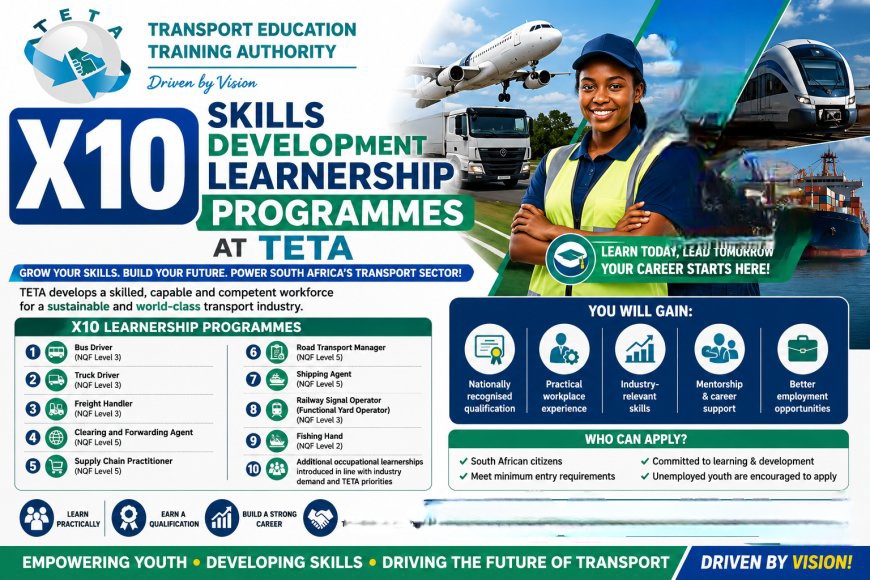
Transport Education and Training Authority (TETA) Skills Development Learnership Programmes: Building a Skilled Workforce for South Africa’s Transport Industry (Part 1
Introduction
The transport industry plays a fundamental role in South Africa’s economic growth and social development. It serves as the backbone of commerce by enabling the movement of goods, services, and people across cities, provinces, and international borders. Efficient transport systems support trade, tourism, manufacturing, mining, agriculture, and countless other sectors that depend on reliable logistics and infrastructure. As the industry continues to evolve through technological innovation, digital transformation, and changing market demands, the need for a highly skilled workforce has become increasingly important.
Developing skilled professionals who can meet modern industry standards requires more than traditional classroom education. It demands practical workplace experience, industry-specific knowledge, and nationally recognized qualifications that prepare individuals for real-world employment. This is where the Transport Education and Training Authority (TETA) plays a significant role.
The Transport Education and Training Authority (TETA) is one of South Africa’s Sector Education and Training Authorities (SETAs), established to facilitate skills development within the transport sector. Through various education, training, and workplace learning initiatives, TETA works to address skills shortages while improving employment opportunities for young people, unemployed graduates, and existing employees.
Among its most successful initiatives are the Skills Development Learnership Programmes. These programmes combine structured theoretical instruction with supervised workplace training, enabling learners to gain valuable experience while working toward nationally recognized occupational qualifications. Learnerships bridge the gap between education and employment by ensuring that learners develop both technical competence and practical workplace skills.
For many South Africans, particularly unemployed youth, TETA learnerships represent more than just training opportunities—they provide pathways to meaningful careers, increased employability, and lifelong professional growth. Employers also benefit by gaining access to trained individuals who understand industry standards, safety regulations, operational procedures, and customer service requirements.
This comprehensive article explores the Transport Education and Training Authority Skills Development Learnership Programmes, their objectives, benefits, application processes, qualifications, workplace learning experiences, career opportunities, and their contribution to South Africa’s broader economic development.
Understanding the Transport Education and Training Authority (TETA)
The Transport Education and Training Authority (TETA) is responsible for promoting education, skills development, and training across South Africa’s transport sector. Operating under the Skills Development Act, TETA collaborates with government departments, employers, training providers, educational institutions, and labour organizations to strengthen workforce capabilities.
Its primary responsibility is to ensure that employees and future workers possess the competencies required to meet industry needs while supporting national economic priorities.
TETA focuses on several transport subsectors, including:
Freight logistics
Passenger transport
Road freight
Rail transport
Maritime transport
Aviation
Taxi industry
Bus transport
Ports and harbours
Courier services
Warehousing
Supply chain management
Each subsector requires specialized skills, and TETA develops training interventions that address current and future workforce demands.
The Importance of Skills Development in South Africa
Skills development remains one of South Africa’s highest national priorities. High unemployment, particularly among young people, continues to present economic and social challenges.
Many job seekers struggle because they lack:
Practical work experience
Occupational qualifications
Industry certifications
Workplace exposure
Professional networks
Employers, meanwhile, often report shortages of skilled workers despite high unemployment levels.
This mismatch between education and labour market needs makes workplace learning programmes increasingly valuable.
Skills development contributes to:
Economic growth
Increased productivity
Poverty reduction
Youth empowerment
Social inclusion
Innovation
Business competitiveness
Learnerships help close this gap by combining education with employment-based learning.
What Are TETA Skills Development Learnership Programmes?
A learnership is a structured learning programme that combines classroom-based education with practical workplace experience.
Unlike traditional academic studies, learnerships emphasize hands-on learning in real working environments.
Participants:
Attend formal training sessions
Complete workplace assignments
Learn under experienced supervisors
Build practical competencies
Complete assessments
Earn nationally recognized qualifications
Most learnerships are registered on South Africa’s National Qualifications Framework (NQF), ensuring that qualifications meet national quality standards.
The duration of a learnership typically ranges from 12 to 24 months, depending on the qualification and occupational field.
Objectives of TETA Learnership Programmes
TETA has designed its learnership programmes to achieve multiple objectives.
These include:
1. Reducing Skills Shortages
Many transport occupations require technical knowledge and specialized training.
Learnerships develop skilled professionals capable of meeting industry requirements.
2. Improving Employability
Employers often prefer candidates with practical experience.
Learnerships allow participants to gain workplace exposure before entering the job market permanently.
3. Supporting Economic Growth
An efficient transport system depends on competent professionals.
Improved workforce skills increase productivity throughout supply chains and logistics operations.
4. Youth Employment
Many TETA programmes specifically target unemployed youth.
These initiatives create pathways into sustainable employment while addressing youth unemployment.
5. Supporting Transformation
TETA promotes inclusive participation by encouraging applications from:
Women
Persons with disabilities
Previously disadvantaged communities
Rural populations
Unemployed graduates
6. Developing Occupational Competence
The programmes help learners acquire:
Technical knowledge
Workplace discipline
Communication skills
Customer service skills
Safety awareness
Digital competencies
Teamwork abilities
Leadership potential
Why Learnerships Matter
Traditional education often provides theoretical knowledge but limited workplace experience.
Employers increasingly seek candidates who can:
Solve practical problems
Operate industry equipment
Follow workplace procedures
Understand occupational health and safety
Work in teams
Communicate professionally
Adapt to changing technologies
Learnerships provide these experiences before learners enter permanent employment.
The Structure of TETA Learnerships
Every TETA learnership follows an integrated learning model consisting of two primary components.
Classroom Learning
Learners attend structured training delivered by accredited training providers.
Subjects may include:
Industry legislation
Transport operations
Business communication
Customer service
Safety procedures
Computer literacy
Logistics management
Supply chain principles
Workplace Learning
Learners spend significant time working within transport companies.
They learn directly from experienced employees while applying classroom knowledge.
Practical training may involve:
Warehouse operations
Fleet management
Dispatch coordination
Vehicle inspections
Cargo handling
Customer interactions
Administrative duties
Logistics planning
Industries Supported by TETA
TETA supports numerous industries that contribute to South Africa’s economy.
Road Freight
Road freight companies transport goods throughout South Africa.
Learnerships prepare individuals for careers involving:
Fleet operations
Vehicle scheduling
Cargo management
Driver coordination
Compliance monitoring
Passenger Transport
Passenger transport includes:
Bus services
Taxi operations
Shuttle services
Tourism transport
Training emphasizes customer service, safety, scheduling, and operational efficiency.
Rail Transport
South Africa’s rail sector continues to modernize.
Learners may receive training in:
Rail operations
Maintenance
Safety systems
Signalling
Infrastructure support
Maritime Industry
Ports and shipping remain essential for international trade.
Training may include:
Cargo handling
Port logistics
Maritime safety
Shipping administration
Freight documentation
Aviation
The aviation industry requires highly trained professionals.
Possible learning areas include:
Airport operations
Passenger services
Cargo logistics
Ground handling
Aviation safety
Warehousing and Distribution
Modern warehouses rely on technology and efficient inventory systems.
Learners gain experience in:
Stock control
Inventory management
Picking and packing
Warehouse safety
Distribution planning
Nationally Recognised Qualifications
One of the biggest advantages of TETA learnerships is that successful learners receive nationally recognised qualifications.
These qualifications are:
Industry approved
Quality assured
Nationally accredited
Employer recognised
Career enhancing
Holding a recognised qualification improves employment prospects throughout South Africa.
Who Can Apply?
Eligibility requirements differ between programmes.
However, applicants commonly need:
South African citizenship
Valid South African ID
Appropriate educational qualifications
Willingness to complete workplace training
Good communication skills
Commitment to learning
Some programmes require:
Grade 12 (Matric)
Driver’s licence
Computer literacy
Medical fitness
Background checks
The Learning Experience
During the programme, learners participate in a structured educational journey.
Typical activities include:
Classroom lectures
Practical demonstrations
Group projects
Workplace assignments
Mentor meetings
Skills assessments
Portfolio development
Final evaluations
This integrated approach develops both theoretical understanding and practical competence.
Mentorship and Workplace Support
An important feature of TETA learnerships is mentorship.
Each learner typically works under experienced supervisors who provide:
Daily guidance
Skills coaching
Performance feedback
Career advice
Workplace support
Mentors help learners adapt to professional environments while improving confidence and competence.
Building Essential Workplace Skills
Beyond technical knowledge, TETA programmes focus on developing transferable workplace skills that are valuable across industries.
These include:
Communication
Time management
Teamwork
Leadership
Professional ethics
Conflict resolution
Critical thinking
Problem-solving
Adaptability
Customer service
These competencies contribute significantly to long-term career success.
Digital Skills in Modern Transport
Technology is transforming transport operations.
Today’s professionals increasingly work with:
Fleet management software
GPS tracking systems
Warehouse management systems
Electronic documentation
Inventory software
Transport management systems
Data analytics
Mobile communication tools
TETA learnerships increasingly incorporate digital literacy to prepare learners for technology-driven workplaces.
Workplace Safety
Safety remains one of the transport industry’s highest priorities.
Learners receive training on:
Occupational Health and Safety (OHS)
Hazard identification
Risk assessment
Emergency procedures
Personal protective equipment (PPE)
Safe equipment handling
Incident reporting
Understanding safety regulations helps reduce workplace accidents while protecting employees and the public.
Supporting Career Development
Completing a TETA Skills Development Learnership Programme is often the beginning of a professional journey rather than the end. Learners gain practical experience, industry exposure, and nationally recognised qualifications that can open doors to employment and further study. Many participants continue into advanced occupational training, supervisory roles, apprenticeships, or higher education related to logistics, transport management, supply chain operations, and other specialised fields.
In addition to technical skills, the confidence gained through workplace learning helps participants adapt more easily to professional environments and build long-term careers in South Africa’s transport industry.
Conclusion of Part
The Transport Education and Training Authority (TETA) plays a vital role in strengthening South Africa’s transport sector by investing in people. Its Skills Development Learnership Programmes combine structured education with practical workplace experience, helping learners gain nationally recognised qualifications while developing the competencies employers value most.
By addressing skills shortages, supporting youth employment, promoting workplace readiness, and fostering inclusive economic participation, TETA contributes to a more capable and competitive transport workforce. These programmes not only benefit individual learners but also enhance the efficiency and sustainability of the transport and logistics industry as a whole.